Water under a washer is worth fixing this week, because the damage goes into the floor and the cabinets rather than into the machine. Most of the job is finding where the water starts, and the point in the cycle it shows up tells you that.
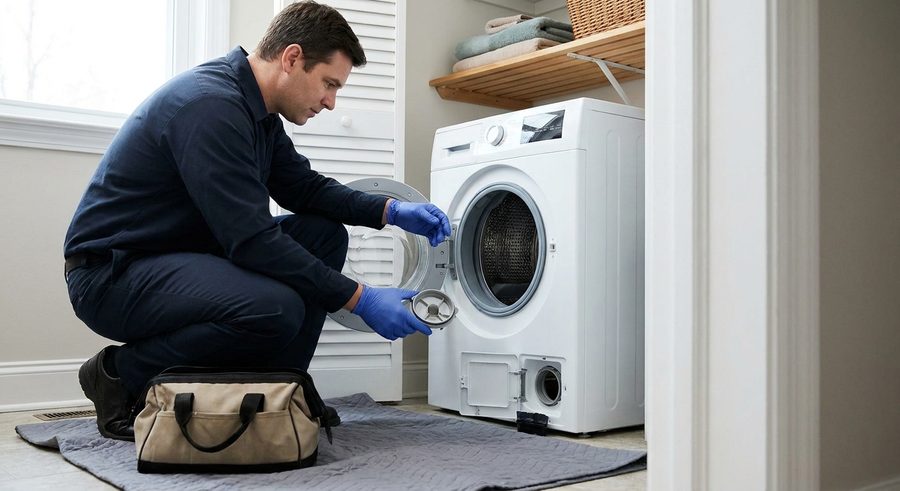
What to check, in order
Free checks first. The cheap causes are also the common ones.
Note when the water shows up
During fill, during wash, during drain, or all the time. That one observation narrows it more than anything else. All the time points at a supply connection. During drain points at the pump or the drain hose. During wash points at the tub or a seal.
Check both ends of both supply hoses
Check at the wall valve and at the back of the machine. A connection that weeps leaves a small steady puddle that looks like a serious fault and is often a quarter turn from being fixed. If a hose is bulging or crusty at the ends, replace it.
Put paper towel down and run a short cycle
It shows you where the water first reaches the floor, which is usually close to where it is coming from. Take a photo of it. It is the most useful thing you can give us on the phone.
Check the standpipe
Look at where the drain hose goes into the pipe in the wall. If that pipe backs up, water comes out around the hose and looks exactly like a leaking washer. In that case the washer is fine and the drain is the problem.
Where to stop
A pump seal, a tub seal or a split internal hose all mean the machine comes apart, and a tub seal in particular is a deep job. Shut the water off at the valves and call. Tell us where the water shows up and at what point in the cycle. The drain pump itself runs $180 to $400. Running it week after week is the expensive choice, because the machine survives a slow leak and the subfloor underneath it does not.
- Behind a panel there are live terminals, sharp edges and sometimes a sealed refrigerant circuit.
- Replacing a part you guessed at is the expensive way to diagnose. A meter settles in a minute what a parts order settles in a week.
- If the machine is inside a manufacturer warranty, opening it yourself can end that cover.
- A burning smell or a scorched connector means stop, unplug it and leave it.
What the repair runs if it is not a free fix
| Part | Typical range |
|---|---|
| Drain pumpNearly always the cause of a machine that will not drain | $180 to $400 |
| Lid or door lock switchThe usual reason a washer will not spin or will not start | $140 to $300 |
| Drive belt or motor couplerWill not spin, or spins without agitating | $150 to $350 |
| Water inlet valveWill not fill, or fills slowly | $150 to $320 |
| Water level or pressure sensorStopping mid cycle, or overfilling | $160 to $350 |
| Suspension rods or dampersWalking across the floor on spin, where levelling has not fixed it | $200 to $450 |
| Main control boardDiagnosed last, because a cheaper sensor usually explains the same symptom | $300 to $650 |
| Drum bearing or outer tubFrequently the point at which a replacement becomes the better value | $600 to $1,200 |
For comparison, a replacement typically runs $700 to $1,600 installed, which is the figure to compare against rather than the shelf price.
Questions people ask
Is it worth repairing, or should I replace it?
Fix it if the repair costs well under a new one and the body of the machine is still sound. Saving on energy is real but slow. It rarely catches up with a repair that costs a fraction of a new unit. A diagnosis costs less than the wrong new appliance. Start there.
What counts as urgent and what can wait?
Urgency comes from the damage a fault is doing, not from how much it annoys you. An oven that will not heat is an inconvenience. An oven that will not switch off is a hazard. Lead with the water or the food when you call, not with the brand.
What should I do to get ready?
The model number. It is worth more than any description of the symptom. Keep any paperwork you have. A machine still inside the maker's warranty takes a different route entirely. Call us and read the model number straight off the sticker.
Related questions
What a refrigerator repair costsMost refrigerator repairs cost $120 to $700.How much it costs to fix a refrigeratorA refrigerator repair usually runs $120 to $700, and the part that failed decides where you land in that range.Whether a washing machine is worth repairingMost washer repairs are worth doing, because the parts that usually fail run $140 to $400.Past the free checks?
Call with the model number and the list of what you already tried.
(716) 414-5233