Any built in and over the range microwave repair is two jobs: finding out what broke, and the part to fix it. Most of the time the part that failed is a cheap one, so a tech checks those first.
Built in, over the range and microwave drawer units only. A countertop microwave costs less to replace than to repair, so it is not worth a service call.
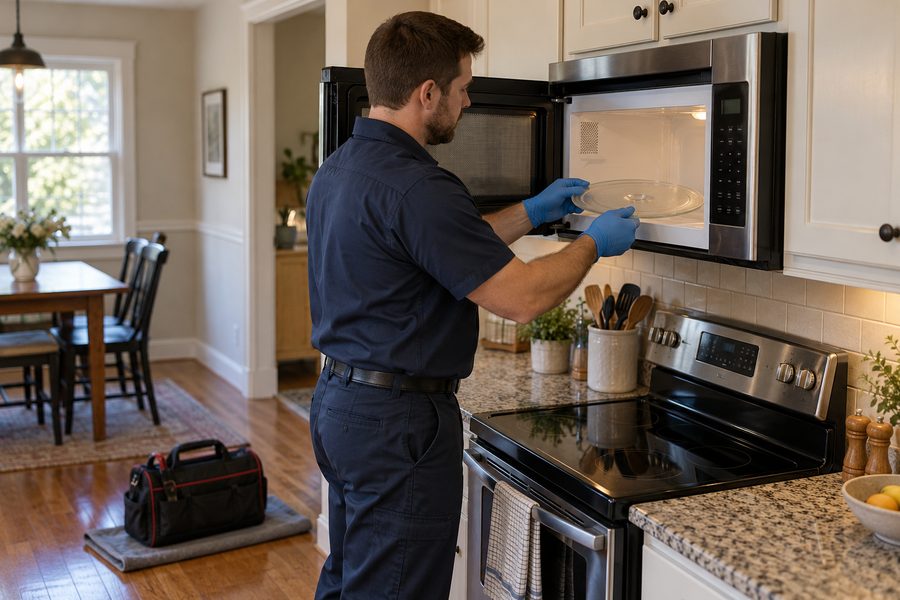
What usually fails
- Runs but does not heat, which is the magnetron, the high voltage diode or the capacitor
- The turntable or the fan working while nothing warms, the classic magnetron signature
- Door latch switches failing, which stops the unit dead and is the most common fault on an over the range model
- The vent fan failing on an over the range unit, which is a separate motor from the cooking side
- A control panel that has gone unresponsive behind the membrane, common on units above a hot range
The part sets the price, not the appliance and not where you live. Have the model and serial number off the sticker when you call. Two machines with the same name on the door can take different parts, and the sticker is the only thing that tells us which.
Typical ranges by part
| Part | Typical range |
|---|---|
| Door latch switch assemblyThe most common fault on an over the range unit, and it stops the appliance dead | $160 to $350 |
| MagnetronRuns, turntable and light work, nothing heats. The classic signature | $280 to $550 |
| High voltage diode or capacitorSame symptom as a magnetron and cheaper, so it is tested first | $200 to $420 |
| Vent or exhaust fan motorA separate motor from the cooking side on an over the range model | $200 to $450 |
| Control panel or membraneCommon on a unit mounted above a hot range | $250 to $550 |
| Turntable motorHeats but does not rotate | $140 to $300 |
For comparison, a replacement typically runs $500 to $1,500 installed, which is the figure to compare against rather than the shelf price.
Before you call
Where to find the model numberThe model number, the symptom in your own words, when it started, and what you have already tried.Questions people ask
Can I still get parts for an old appliance?
Usually yes, and older machines are often the easier ones to fix. Doorways and stair turns in an old house decide whether a new machine can physically reach the kitchen at all. The sticker on the machine answers this. Have the numbers ready.
Can an older built in microwave still be worth fixing?
Age by itself does not decide this. Look at what the machine has already needed. Check that the part is still made. A control board nobody builds any more is often the real reason a repair stops making sense. Name the part first, then weigh it against the full fitted cost of a new one.
What should I do first if my built in microwave has stopped?
If food is at risk, it goes to the front of the line. An oven that will not heat is an inconvenience. An oven that will not switch off is a hazard. Call us and describe the symptom. That is what sets the priority.
What should I do to get ready?
Four things make the call useful: the model, the symptom, when it started, and what you already tried. The sticker is inside the fridge on a side wall, or around the door opening on a dishwasher. On a washer it is inside the door or the lid. On a dryer it is on the back or inside the door. On a range, look behind a drawer or on the frame. Have the model number ready and tell us what the machine is doing.
What makes one brand easier to repair than another?
Every mainstream brand is repairable. The question is always the specific part. Several brands are built on the same platform, so a drain pump or a drive motor is often the same part under two names. Call us with the model number. It is the only thing that settles parts.
How much should a repair cost?
Price follows the part, and the parts that fail most often are the cheap ones. Built in units cost more in labor than freestanding ones, because the machine has to come out before anyone can reach the parts. Call us with the model number and the symptom, and ask which part is likely.