A refrigerator repair usually runs $120 to $700, and the part that failed decides where you land in that range. Not cooling can be a $130 to $280 thermistor or $700 to $1,800 of sealed system work. Nobody can give you a real price until somebody names the fault.
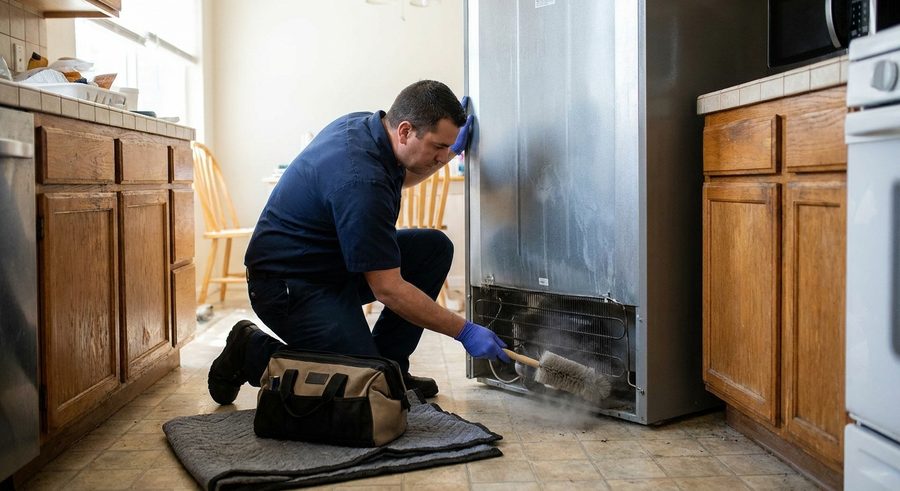
Why two quotes for the same symptom differ
Not cooling is a symptom, not a diagnosis. At least six different parts cause it and they span $120 to $1,800. Two honest shops can be a long way apart on the same phone call, because one of them has guessed and the other has tested.
So ask which part they suspect, then ask what that part costs. A number with no fault attached to it will change once somebody opens the machine, and you want to hear it change before the work starts, not after.
Three questions to ask before you say yes
Ask for the price of the repair, not the price of the part. Those are two different numbers and the gap between them is labor.
Ask whether the part is still made. A discontinued control board is the usual reason a repair stops making sense, and it is better to hear that early than to hear it after a part has been ordered.
Have the model and serial number ready when you call. They are on a sticker inside the fresh food section, usually on a side wall or along the ceiling near the crisper drawers. Two refrigerators with the same name on the door can take different parts, and the sticker tells us which.
What the age of the machine actually tells you
Less than you would think. Age matters through parts, not through labor. A twenty year old refrigerator with simple controls can be an easier fix than an eight year old one with a dead board nobody makes.
History tells you more. One repair on a machine that has never been touched is maintenance. Three repairs in two years is a pattern, and a pattern is the honest reason to stop spending. A new refrigerator runs $900 to $2,600 installed, so the third repair in a row is the one to think hard about.
Typical ranges by part
| Part | Typical range |
|---|---|
| Start relay or overload protectorOne of the two cheap failures worth ruling out first on a unit that is not cooling | $120 to $250 |
| Condenser or evaporator fan motorThe other one. A clicking every few minutes points here or at the relay | $150 to $350 |
| Defrost heater or thermostatHeavy frost on the back wall, or a unit that cools then warms | $180 to $400 |
| Thermistor or temperature sensorRunning constantly without reaching temperature | $130 to $280 |
| Door gasketVaries most by model; a built in gasket costs far more than a freestanding one | $150 to $400 |
| Electronic control boardThe modern cost driver. A mechanical predecessor was a fraction of this | $350 to $700 |
| Compressor or sealed systemThe one real cliff. Opening the refrigerant circuit is a different class of job and is quoted on its own | $700 to $1,800 |
For comparison, a replacement typically runs $900 to $2,600 installed, which is the figure to compare against rather than the shelf price.
What this looks like in an older house
Most of the houses around here are old. In Bradford about three in five went up before 1940, and Warren, Olean and Jamestown are all above half. In a house that age the cabinet opening, the doorway and the circuit were all sized for a smaller machine than anything sold today.
So a new one often needs work doing before it even fits, and none of that shows on the price tag. A repair skips it. What the fit problem costs in an older house.
Questions people ask
Should I repair this appliance or buy a new one?
Repair wins most of the time, as long as the tub, the drum and the cooling system are still good. Count the other repairs it has had. One at ten years old is normal wear. Three in two years is a pattern. Ask what failed, what the part costs, and whether the part is still made.
Is an appliance from the eighties or nineties still worth fixing?
Older is often simpler, and simpler is cheaper to fix. A machine built before electronic diagnostics is often faster to fault find, not slower, because you can see what failed. Ask about the part, not the age of the machine.
What makes one brand easier to repair than another?
Across the common brands, the things that fail are more alike than different. Counter depth and standard depth models often take different doors and gaskets even though they look identical. Read the model and serial off the sticker before you call.
Related questions
Repair or replace an appliance in an older houseIn an older house this is a fit question before it is an appliance question.How long appliances lastMost major appliances last 8 to 20 years.Dishwasher not drainingStanding water in the bottom of a dishwasher is usually a blocked filter, a blocked air gap, a kinked drain hose or a dead drain pump.Get the fault named first
The part decides the price, so the diagnosis comes before the figure.
(716) 414-5233