Start with the condenser coil and the door seal, because both are free to check and both stop a refrigerator from cooling. After that, the likely causes are the start relay ($120 to $250), a fan motor ($150 to $350) or the defrost system ($180 to $400). Sealed system work ($700 to $1,800) comes last.
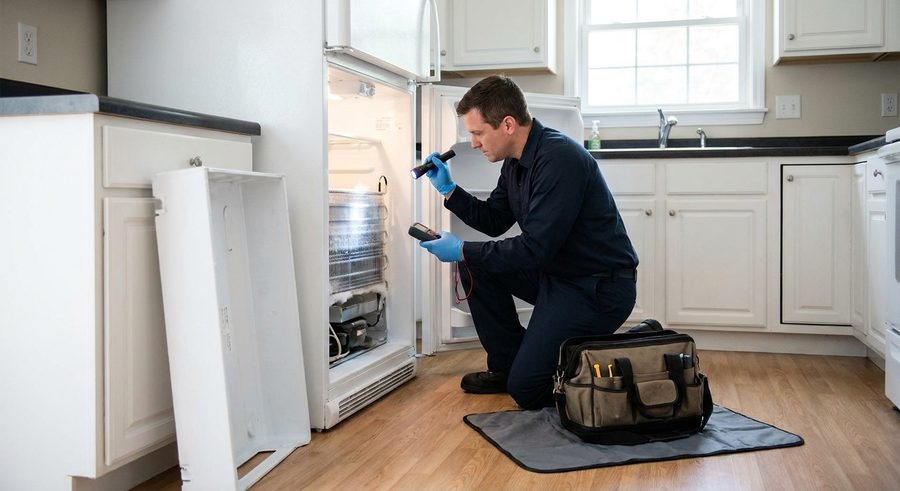
What to check, in order
Free checks first. The cheap causes are also the common ones.
Work out whether it is running at all
Stand still and listen for the compressor, the low hum from the bottom at the back. A silent refrigerator is a different problem from one that runs and will not get cold, and knowing which one you have cuts the list of causes in half.
Clean the condenser coil
It is behind the grille at the bottom front, or across the back on older units. Unplug the refrigerator and vacuum the dust out of the fins and off the fan behind them. A coil packed with dust makes the machine run all day without ever reaching temperature, and clearing it costs nothing.
Check the door seal
Shut the door on a sheet of paper and pull. If it slides out with no grip anywhere along the seal, warm air is getting in faster than the refrigerator can take heat out, and a gasket runs $150 to $400.
Listen for a click every few minutes
A click followed by silence is the start relay trying to get the compressor going and failing. It is one of the cheap failures at $120 to $250, so tell us if you heard it.
Check whether the freezer is still cold
A cold freezer with a warm fresh food section is good news. It means the sealed system is working and the problem is getting cold air from one side to the other, usually the evaporator fan or the damper between the two.
Where to stop
Past the coil and the seal, the relay, the fans and the defrost system all need a meter to test. The sealed system needs a licensed tech with recovery equipment. That is the point to call. Move what you can into a cooler while you wait. A fresh food section sitting above 40 degrees is not keeping food safe, and a full load of groceries costs more than most of these repairs.
- Behind a panel there are live terminals, sharp edges and sometimes a sealed refrigerant circuit.
- Replacing a part you guessed at is the expensive way to diagnose. A meter settles in a minute what a parts order settles in a week.
- If the machine is inside a manufacturer warranty, opening it yourself can end that cover.
- A burning smell or a scorched connector means stop, unplug it and leave it.
What the repair runs if it is not a free fix
| Part | Typical range |
|---|---|
| Start relay or overload protectorOne of the two cheap failures worth ruling out first on a unit that is not cooling | $120 to $250 |
| Condenser or evaporator fan motorThe other one. A clicking every few minutes points here or at the relay | $150 to $350 |
| Defrost heater or thermostatHeavy frost on the back wall, or a unit that cools then warms | $180 to $400 |
| Thermistor or temperature sensorRunning constantly without reaching temperature | $130 to $280 |
| Door gasketVaries most by model; a built in gasket costs far more than a freestanding one | $150 to $400 |
| Electronic control boardThe modern cost driver. A mechanical predecessor was a fraction of this | $350 to $700 |
| Compressor or sealed systemThe one real cliff. Opening the refrigerant circuit is a different class of job and is quoted on its own | $700 to $1,800 |
For comparison, a replacement typically runs $900 to $2,600 installed, which is the figure to compare against rather than the shelf price.
Questions people ask
What information helps most on the phone?
Write down what the machine is doing, in your own words, before you call. Describe what it does, not what you think is wrong. What it sounds like and what it smells like beats a guess at the cause. Have the model number and the error code ready when you call.
Should I try anything before calling?
Sometimes, yes. A few faults really are ones you can fix yourself, and they are worth ruling out before you pay anyone. If the machine is still under the maker's warranty, opening it up yourself can end that cover. Check before you start. If it is past the filters and the breaker, get it looked at.
What makes one brand easier to repair than another?
Brand matters less than people expect, and parts supply matters more. The sticker settles it. Two machines with the same name on the door can take different parts. Ask what the part is and whether anybody still makes it.
Related questions
Dryer squeakingA squealing or thumping dryer is usually worn drum rollers, a worn idler pulley or a rear drum bearing.Washer leaking from the bottomWater under a washer is worth fixing this week, because the damage goes into the floor and the cabinets rather than into the machine.Oven not heating upAn oven that will not heat is almost always one part: the bake element on an electric oven, the igniter on a gas one.Past the free checks?
Call with the model number and the list of what you already tried.
(716) 414-5233